English| USD
Suggested for you
More currencies
Choose a language
In Porto they are everywhere — small three-wheeled vehicles idling below the Sé, threading the granite lanes toward Miragaia, waiting near São Bento. Travellers see them long before they understand what they are booking. This page explains the vehicle, the service behind it, and what a ride through the city actually involves.
Quick answer
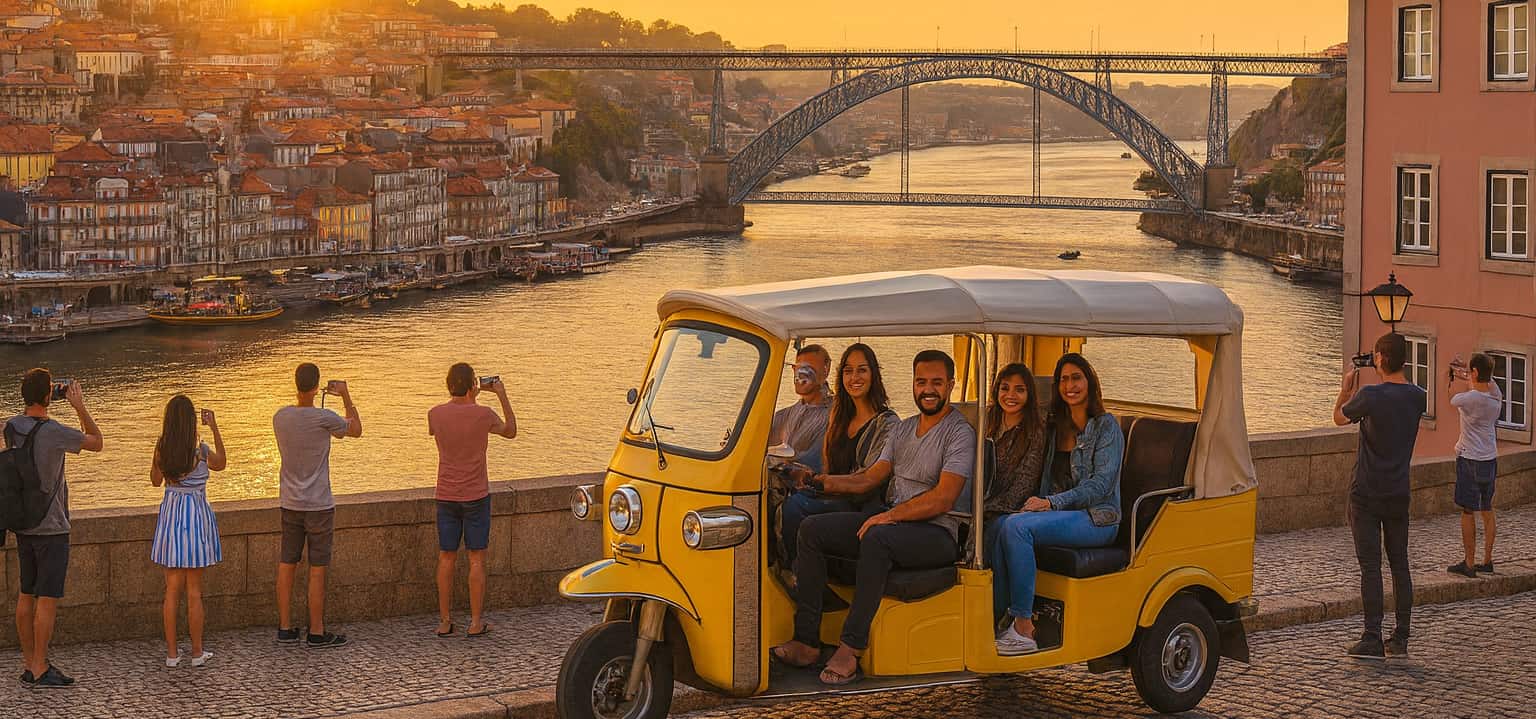
A tuk tuk in Portugal is a licensed three-wheeled passenger vehicle, usually electric, seating four to six people with a driver-guide. It is not public transport and not a taxi: it operates as a guided sightseeing service. In Porto these run daily, 09:00–19:00, from various pickup locations throughout the city centre rather than a single ticketed venue.
Porto's tuk tuks are almost all electric — a quiet detail that matters more than it sounds. The historic core is a UNESCO World Heritage site of granite setts and gradients steep enough to defeat a coach, and the city's noise and emissions rules pushed operators toward battery-powered fleets years ago. The result is a vehicle that climbs from the Douro quayside to the Torre dos Clérigos without the diesel clatter that once accompanied it. Anyone asking what is a tuk tuk in Portugal is usually picturing the Bangkok original: a small auto-rickshaw, open at the sides, three wheels, a canopy roof. The Portuguese version borrows the shape and changes the purpose. Here the vehicle is a licensed tourist-transport unit with a driver who works as a guide, commentary included, following a route rather than a meter. Fleets carry four to six passengers. Seatbelts, roll bars and side rails are standard, and drivers hold a professional licence issued under national transport rules. Locals call them tuk tuks too — the word has entered everyday Portuguese unchanged, though you will also hear moto-táxi and triciclo turístico in official listings. The geography explains the appeal. A Porto tuk tuk tour reaches places larger vehicles cannot: the Escadas do Codeçal, the tight ascent to the Sé, the riverside road under the Ponte Dom Luís I, the lanes of Miragaia and the climb toward the Jardim das Virtudes with its terraced Douro views. Bus tours stop at the edge of these districts. Foot routes cross them slowly, at considerable cost to the knees. The three-wheeler splits the difference, covering Porto landmarks in a compressed loop while remaining small enough to stop wherever a photograph is worth taking. What a visitor should do with this answer is mostly a matter of sequencing. A tuk tuk sightseeing ride works best as an orientation on a first morning — a way to learn which hill holds which church before returning on foot to the ones that earned a second look. Vila Nova de Gaia's port lodges, Foz do Douro and the Bolhão market district all sit within common route ranges. Anyone still weighing what is a tuk tuk in Portugal against a walking tour should read this guide alongside the timing and pickup sections below, where the practical scheduling detail lives.
“Bus tours stop at the edge of these districts; foot routes cross them slowly, at considerable cost to the knees.”
Tuk tuks in Porto are specialized, electric-powered vehicles engineered to navigate the city's complex urban layout. They provide a compact mode of transport suited for the historic center's steep inclines and narrow alleyways.
The modern Porto tuk tuk fleet operates on electric motors, eliminating exhaust emissions while maintaining enough torque to climb the city's granite-paved hills.
Each vehicle is built with a narrow wheelbase specifically designed to traverse streets too tight for standard buses or large automobiles.
The design prioritizes passenger visibility through an open-sided structure, allowing for 360-degree views of Porto's architectural facades and riverfront.
Vehicles are equipped with reinforced suspension to handle the vibration and uneven surfaces common on Porto's traditional cobblestone roads.
Although open to the air, each tuk tuk features a retractable roof and side curtains to protect passengers during rainy conditions.
These vehicles are subject to specific licensing and safety regulations that mandate seat belts and regular mechanical inspections for public transport usage.
Tuk tuks in Porto do not operate from fixed stations or public transport terminals. Instead, services utilize various pickup locations throughout the city center as designated during the booking process.
Line D (Yellow) to São Bento Station
Lines 200, 207, or 300 to Praça da Liberdade
Walk to established city center meeting points
Direct drop-off at centrally located squares
Coordinate your specific pickup location in advance, as there are no fixed tuk tuk stops. Aim to arrive at your confirmed meeting point during the 09:00–18:00 window to avoid peak traffic congestion in narrow historic streets.
Tuk tuk services in Porto operate daily to accommodate visitors exploring the city's historic streets. Operations are consistent throughout the week.
Maximize your experience in Porto by optimizing how you utilize these compact vehicles for city exploration.
Tuk tuks accommodate a maximum of three to six passengers depending on the model, so coordinate your group size in advance to ensure you fit comfortably. Requesting a vehicle for smaller groups often allows for better maneuvering through the tightest historic corners.
Use these vehicles strategically to handle the steep inclines of the Ribeira and Cedofeita districts. Starting your tour at a low point and using the tuk tuk to ascend saves significant energy for later walking.
Ask your driver to focus the route on residential areas like Miragaia rather than just the main tourist thoroughfares. Drivers often know specific viewpoints that are inaccessible to larger tour buses.
Even on sunny days, wind chill is a factor when riding in an open-sided vehicle. Carry a light jacket or scarf regardless of the season to remain comfortable while the vehicle is in motion.
Discuss your interest in photography with your driver before departure. They can provide brief pauses at specific azulejo-tiled facades that you might miss while moving at cruising speed.
Everything you need to know about what is a tuk tuk in portugal
In Porto, a tuk tuk is a small, motorized three-wheeled vehicle designed for navigating the city's narrow, winding historic streets. They serve as a popular alternative to traditional walking tours for those wanting to see local landmarks efficiently.
Yes, these tours are often a hit with families because they provide a fun, open-air way for children to see the city without tiring them out. The compact nature of the vehicle allows families to access areas that larger buses cannot reach.
Tuk tuks in Portugal are primarily utilized as private hire transport for guided sightseeing tours. They offer a personalized experience, allowing visitors to view architecture and historic sites comfortably from an elevated seating position.
You can reserve your spot through our booking platform, which provides access to various service providers operating throughout the city. We recommend planning your experience in advance to ensure availability for your preferred day.
These vehicles are specifically engineered to navigate the steep terrain and cobbled alleys characteristic of Porto. This makes them a practical choice for guests who prefer to avoid long climbs while exploring the city's heritage.
These vehicles operate daily from 09:00 to 19:00. This schedule allows visitors to plan their city exploration throughout the week, ensuring flexibility for various travel itineraries.
Porto Tuk Tuk City Tour Options
Read more GuidePorto Tuk Tuk Tour Reviews & Reddit Feedback
Read more Tickets & toursPorto Tuk Tuk Rides & Short Trips
Read more Tickets & toursPorto Half Day Private Tuk Tuk Tours
Read more Tickets & toursPrivate Tuk Tuk Tours in Porto
Read more GuidePorto Tuk Tuk Tour Prices & Booking Guide
Read more Tickets & toursPorto Tuk Tuk Tour & Douro River Cruise Combo
Read more